
The Science Behind Porn Addiction
Access our program
Back to Table of Contents
The Science Behind Porn Addiction
Pornography addiction is a complex behavioral disorder with significant implications for individuals and their relationships. Understanding the underlying scientific mechanisms that drive this addiction is essential in developing effective treatment approaches and promoting public awareness. This section explores the science behind pornography addiction, focusing on neurological mechanisms, psychological factors, triggers, and cravings.
Neurological Mechanisms and Reward Pathways
Neurocientists have identified specific neural structures in the brain specifically in the brain’s reward system that play a crucial role in addiction.
The reward system is what motivates us to engage in behaviour which we find pleasurable such as eating and sex. Current evidence suggest that porn addiction (and all other addictions) hijacks this system, rewiring it to produce abnormally strong motivations to pursue the addiction, in some people, sometimes to the exclusion of almost anything else.
The porn addicts brain is doing that same thing brains have always done since these structures appeared on earth. The things brains must do in order to survive. It’s learning. The problem is that the addict’s brain is being tricked into learning behaviour that can be harmful rather than helpful.
Factors relating to abuse, dependence and craving are central to the concept and assessment of addiction.
a) Abuse
For behaviour to be considered an addiction, it has to lead to significant negative consequences. Porn addicts may continue in their impulsive, consistent porn use despite significant negative consequences or the potential of them. So a partner giving an ultimatum to stop using porn may not be enough to curb the behaviour potentially leading to the loss of a cherished relationship.
b) Dependence
The concept of tolerance is relevant here. Porn addicts often need to watch more or more extreme porn to achieve the same high over time. In this circumstance the brain and body have changed to compensate for the chronic use of pornography. Therefore if porn use is eliminated the brain needs to change back and that can take some time and during that time the porn user can experience withdrawal symptoms.
c) Withdrawal
If a porn addict abruptly stops using porn they can often experience very unpleasant physical and psychological symptoms. Some porn users describe needing porn just to feel normal and without it their day to day functioning at home, work or study deteriorates.
Addiction is associated with specific changes in the brain and when we understand those changes behaviours that at first seem incomprehensible start making sense.
d) Craving
Intense desire to use porn. Environmental cues can become a strong use for using porn. Eg being alone in the house, or just arriving home from work during a stressful period.
Let’s dive a bit deeper into these mechanisms to gain a more thorough understanding.
The psychology and neuroscience of reward
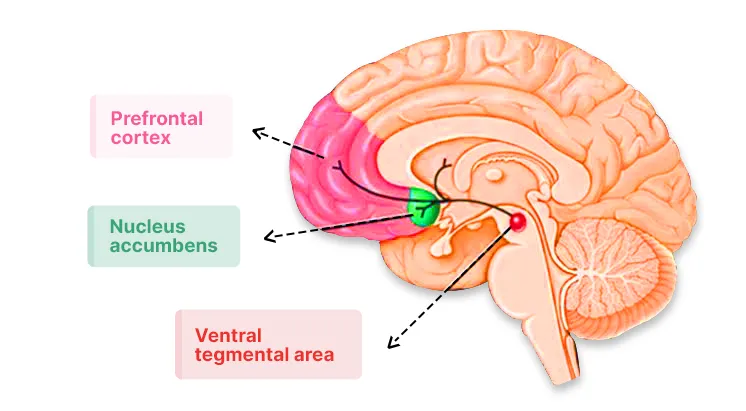
The brain structures in and around the septal region form a neural circuit responsible for processing rewards and motivating us to pursue them. This circuit plays a crucial role in normal behaviors like eating and also contributes to porn addiction.
There are three main components of the brain involved in processing reward:
The nucleus accumbens, often called the brain’s pleasure centre, is a region that both humans and rats repeatedly stimulate to the exclusion of everything else in self-stimulation studies. It’s located above and just behind your sinuses, near the midline of the brain. This region is associated with a wide range of pleasures.
The prefrontal cortex, situated in the front part of the frontal lobe, is often described as the CEO of the brain. It plays a central role in processing rewards and controlling addictive behavior by setting and ensuring the accomplishment of goals.
The ventral tegmental area (VTA) is located in the midbrain, at the top of the brainstem, which is the most primitive part of the brain. The VTA is positioned near the middle of the head, just slightly above the ears and a few centimetres behind and below the nucleus accumbens. Brain cells in the VTA project to both the nucleus accumbens and areas responsible for self-control. These cells are particularly interesting because of their involvement in reward processing.
Porn overstimulates the brain’s reward circuit and repeated overstimulation leads to specific changes in the brain that gives birth to addiction.
Neural changes in addiction
a) Numbing of the pleasure response in the nucleus accumbens
Many researchers believe that tolerance reflects the brains attempt to compensate for repeated overstimulation of the reward circuit and it does so by inhibiting the stimulation of the nucleus accumbens thereby numbing the pleasure response.
The body has internal mechanisms which maintain equilibrium. This is called homeostasis. For example we have mechanisms to maintain our body temperature at a relatively constant level. It is like a biological thermostat.
How does that fit with porn addiction. Well, it means that over time the porn addict needs to engage with more and more to get the same “high”. That might mean more time engaging with porn or escalating to more extreme versions of porn for example. Unfortunately this process can also reduce pleasure received from more everyday activities such as socialising and engaging with hobbies. These activities won’t provide the same level of pleasure they once did. In extreme cases porn becomes the only way to feel good.
b) Stronger associations with porn related cues and increases cravings
Craving or wanting is different from liking. Liking occurs in the nucleus accumbens and the nucleus accumbens is getting numb and as this occurs how much porn is liked declines but the degree to which it is wanted increases. Porn cravings tend to increase while the pleasure of porn declines. What determines this.
We need to turn to the VTA. The VTA is more associated with reward prediction. Neurons in the VTA fire when a reward is unexpected. This is one reason why some porn users escalate to genres outside their normal sexual identity. Novelty is by definition the unexpected in our case. When VTA neurons fire they release a chemical neurotransmitter called dopamine. Dopamine is central in addiction. It has been called the “addiction molecule”. Dopamine plays a role in every addiction that has been studied including internet pornography.
Dopamine isn’t about reward or pleasure. Current evidence suggests that dopamine is associated with wanting and craving rather than liking. The kind of wanting we are talking about is an impulsive urge rather than a considered decision.
There are at least 2 changes in the dopamine system that can contribute to addiction:
a) Incentive sentization
With repeated use of the porn stimulus the brain becomes sensitised which means it acts more strongly. Thus the cravings get stronger and stronger. The urges can become irresistible.
b) Associative learning
When dopamine is released this means an unexpected reward has arrived and we should pay attention and learn to predict how to receive this reward in the future. Eg a good source of food in our distant past. Dopamine signals that something important has happened and therefore learning is triggered. Location of where porn is used, and other stimuli associated with past use are some of the mechanisms that drive this process in the context we are interested in. Cues can lead to a burst of dopamine and a strong craving to use internet pornography.
c) Weakens inhibition from the prefrontal cortex
Leads to reduced self-control. While the reward centre is concerned with primitive urges the prefrontal cortex is concerned with, among other things, long term decision making. What actions we “should” take rather than just what actions we “Feel” like taking. The prefrontal cortex plays a major role in inhibiting behaviour suggested by the more primitive reward circuit.
Chronic porn users have impaired prefrontal cortex functioning. It has a harder and harder time over -riding the craving coming from the reward circuit. It could be seen as a battle between the reward centre and the prefrontal cortex. With repeated porn use the prefrontal cortex gets progressively weaker and loses the battle more and more.
We should emphasise that you don’t need to become an expert in addiction science to overcome your porn addiction. Just like you don’t need to be able to pull apart your car engine and put it back together if you are just wanting to drive from point A to point B.
Psychological Factors Contributing to Addiction
a) Escapism and Coping Mechanisms
Pornography addiction often arises as a coping mechanism for dealing with stress, other emotional pain, or unresolved psychological issues. The immersive and pleasurable nature of pornographic content can provide temporary relief from negative emotions and everyday pressures. This coping mechanism may develop into a habitual pattern over time, leading to an escape from reality into a fantasy world provided by pornography. This reliance on pornography to cope with emotional distress can foster a cycle of addiction, making it difficult for individuals to address underlying issues effectively.
b) Underlying Trauma and Co-occurring Disorders
In some cases, pornography addiction may be associated with underlying trauma or co-occurring mental health disorders. Traumatic experiences in childhood or adolescence, such as abuse or neglect, can shape an individual’s coping mechanisms and increase their vulnerability to addiction.
Additionally, individuals with conditions like depression, anxiety, or obsessive-compulsive disorder may turn to pornography as a way to alleviate distress or anxiety temporarily. However, this self-medication can lead to the development of a maladaptive coping mechanism that exacerbates the addiction
Understanding Triggers and Cravings
a) Triggers for Pornography Use
Triggers are stimuli or situations that prompt individuals to engage in pornography consumption. Triggers can be external, such as explicit advertisements or suggestive images online, or internal, like negative emotions or feelings of boredom. Understanding triggers is crucial in breaking the cycle of addiction and developing healthy coping strategies.
Certain environmental cues associated with pornography, such as specific websites, locations, or time of day, can act as powerful triggers for individuals seeking a pornographic fix. Moreover, emotional triggers, such as stress, loneliness, or low self-esteem, can prompt the craving for pornography as a means of comfort or distraction.
b) Cravings and the Role of Conditioning
Cravings are intense urges or desires for the object of addiction, in this case, pornography. The conditioning of the brain’s reward system through repeated exposure to explicit content reinforces the connection between pornographic stimuli and the release of dopamine. This process creates strong associative memories between certain cues (visual, emotional, or situational) and the pleasure derived from watching pornography.
As a result, when individuals encounter these cues, even if unintentionally, it triggers a conditioned response in the brain, leading to cravings for pornography. The more these cravings are satisfied, the more ingrained the addiction becomes.
Previous: Introduction to Pornography Addiction
Next: Effects of Pornography Addiction on Physical and Mental Health